For decades, custom software development has helped people do their work better. First came management systems. Then ERPs, CRMs, web platforms, mobile applications and dashboards. They made it possible to store information, automate processes and improve business visibility.
But we are entering a new stage. Software should no longer only display information or execute an action when a user clicks a button. It can now understand context, consult different systems, analyse information, generate proposals and collaborate actively with teams.
This is the real potential of enterprise AI agents.
Much more than a chatbot
When people hear about AI agents, many imagine a conversational assistant. In enterprise software, the reality is very different.
A business agent is not designed only to answer questions. It is designed to work with controlled access to tools, data and business context.
It can consult APIs, review databases, analyse documents, interpret logs, connect with internal systems, recover historical information, execute controlled processes and deliver a structured answer that helps a team make better decisions.
Artificial intelligence stops being an isolated feature and becomes a new layer of enterprise software.
When it makes sense to add an AI agent
Not every process needs artificial intelligence. The strongest use cases appear when teams spend a large part of their time collecting scattered information, analysing incidents, reviewing documentation, interpreting evidence or preparing repetitive reports.
In these cases, the highest cost is often not the final action. It is understanding what happened before the team can act.
That is where an AI agent creates value. It does not replace the professional. It prepares the work.
A real technical case
At Kometasoft, we have built a technical AI agent for one of our projects with a very specific objective: reduce the time needed to investigate operational incidents.
When an error occurs, the agent analyses the available information:
- Technical logs.
- System evidence.
- XML and exchange data.
- Screenshots associated with the incident.
- Related code.
- Previous diagnostics.
- Operational context of the process.
With that information, it generates a structured diagnosis that identifies the most likely cause, the evidence found, the business impact and the recommended next steps for the team.
The important point is that the agent does not assume every incident is a software bug. It can distinguish between a programming error, a configuration issue, expected system behaviour, an external incident or insufficient information to make a decision.

The real return on investment
AI is often presented as valuable because it replaces human work. Our experience points in a different direction.
The greatest return appears when AI removes repetitive work that consumes time but does not create value: searching logs, checking multiple applications, comparing information, reviewing documentation, reconstructing an incident or preparing a report.
All this work can take hours before a developer, project lead or operations specialist even starts solving the problem. An agent can prepare that context in minutes.
The result is a more productive team, more consistent diagnostics and a meaningful reduction in the time needed to resolve incidents.
AI agents do not replace existing software
One of the most common misconceptions is that implementing AI agents means replacing current systems. The opposite is true.
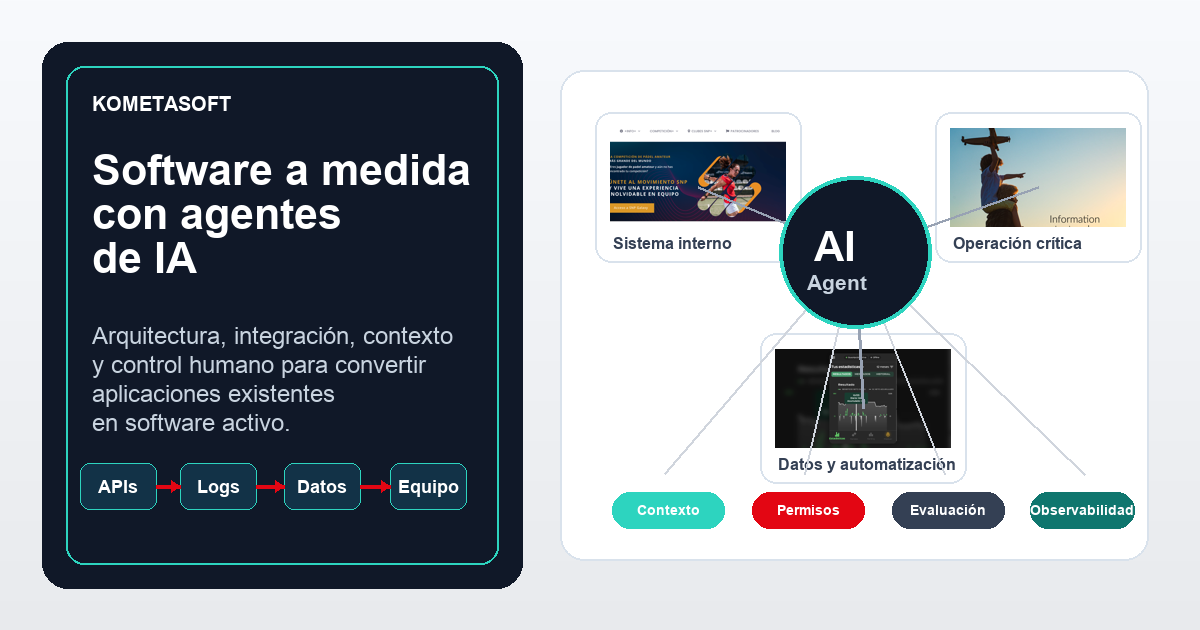
Agents create value because they use the information that already exists inside the company. They connect with current systems, consult existing APIs, access databases, interpret documentation, analyse logs, recover historical knowledge and present information in a structured way for decision-making.
They do not replace the company's technology infrastructure. They make it more useful.
Designed for production
Creating a demonstration with artificial intelligence is relatively simple. Building an agent that can operate every day inside a company is a completely different challenge.
A production-ready agent architecture needs system integration, access control, memory of previous diagnostics, model cost optimisation, human supervision, decision traceability and the ability to evolve with new AI models.
Kometasoft designs LLM-agnostic architectures so each company can use the right model for each case: OpenAI, Anthropic, Huawei, open source models or private models when required.
Artificial intelligence only creates trust when it is safely integrated into real business processes.
A new generation of enterprise software
For many years, software was a passive tool. Users searched for information, executed actions and made decisions.
With enterprise AI agents, a new stage begins. Software can collaborate actively with people: analysing, proposing, connecting information, detecting patterns, generating context and helping teams focus on the work where they create the most value.
Companies will no longer look only for applications that manage information. They will look for applications capable of working alongside their teams.
Kometasoft's vision
At Kometasoft, we believe the future of enterprise software is not about adding a chatbot to an existing application. It is about designing systems that collaborate with people, integrate with each company's technology ecosystem and automate complex tasks under human supervision.
That is the type of solution we are building today: custom software, enterprise AI agent architectures, APIs, cloud infrastructure and intelligent automation designed for production.
Contact Kometasoft if your company wants to evolve its custom software into active systems that support real operations.